
Einleitung
Concrete floors are widely used in warehouses, factories, commercial buildings, parking garages, workshops, and residential properties. Although concrete is strong and durable, its surface is not always ready for the next construction or flooring process. It may contain uneven areas, old coatings, adhesive residues, surface contaminants, laitance, or rough patches that affect the quality of subsequent work.
This is where a grinder for concrete floor preparation becomes essential. A professional concrete floor grinder removes surface imperfections, smooths uneven areas, eliminates old coatings, and creates the correct surface profile for epoxy coatings, polyurethane systems, tile adhesives, and other floor finishes.
Choosing the right grinder for concrete floor preparation can significantly improve construction efficiency and surface quality. Different projects require different grinding capacities, motor powers, working widths, and diamond tooling configurations. A small handheld grinder may be suitable for edges and corners, while a large planetary floor grinder is more appropriate for extensive industrial floors.
In this complete guide, we will explain how a grinder for concrete floor preparation works, explore the different machine types, discuss common applications, and provide practical advice for selecting and operating the right equipment.
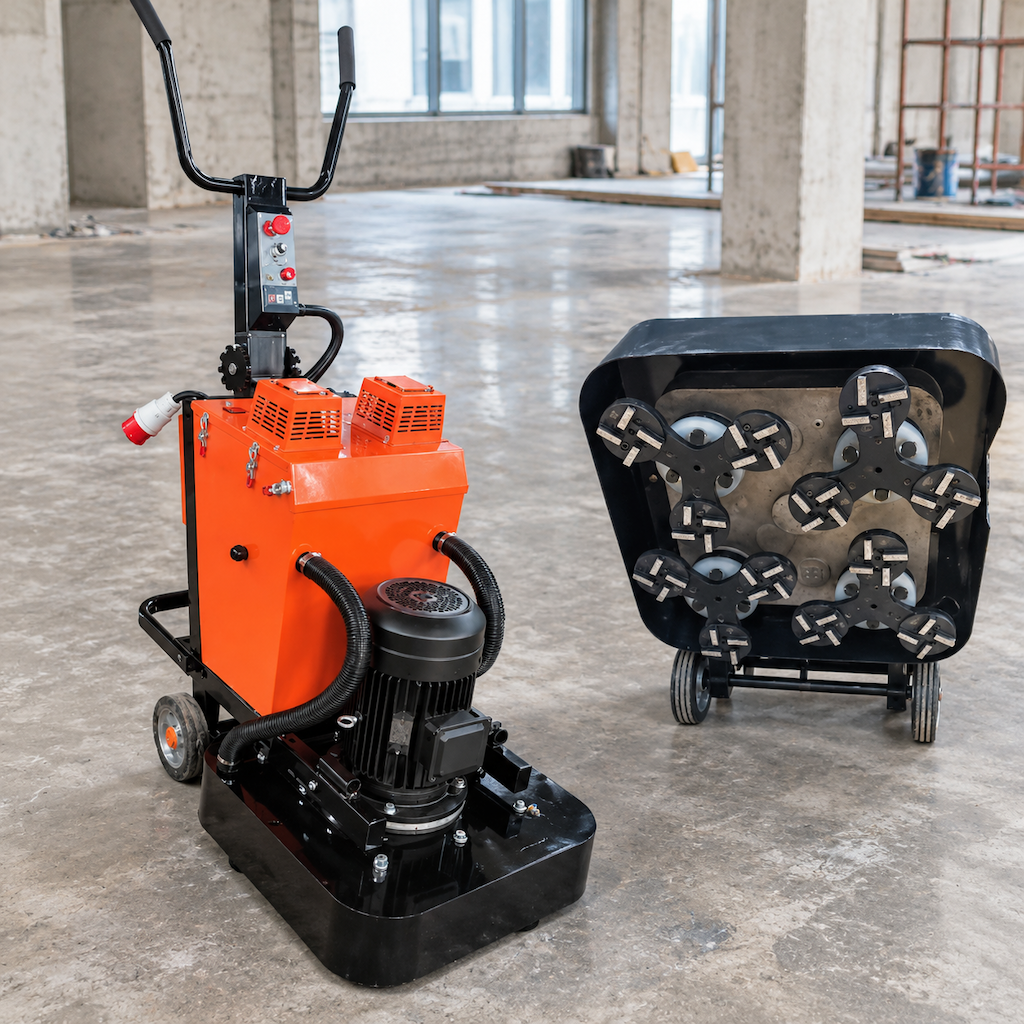
What Is a Grinder for Concrete Floor Preparation?
A grinder for concrete floor preparation is a specialized construction machine designed to mechanically grind and prepare concrete surfaces before applying new flooring materials or protective coatings.
The machine uses rotating diamond grinding tools to remove a thin layer of concrete or unwanted surface materials. Depending on the grinding tool and machine configuration, it can perform light surface cleaning, medium grinding, heavy coating removal, and concrete surface leveling.
Unlike ordinary cleaning equipment, a concrete floor grinder physically changes the surface condition. It can remove weak surface layers and create a consistent profile that improves the adhesion of subsequent flooring systems.
Main Components of a Concrete Floor Grinder
A professional grinder for concrete floor preparation generally consists of several important components:
| Komponente | Funktion |
|---|---|
| Electric motor | Provides power to the grinding system |
| Grinding head | Holds and drives diamond grinding tools |
| Diamond grinding discs | Grind concrete and remove surface materials |
| Getriebe | Transfers motor power to the grinding heads |
| Control handle | Allows the operator to control the machine |
| Staubabsauganlage | Collects dust generated during grinding |
| Water connection | Supports wet grinding when applicable |
| Chassis and wheels | Provide stability and mobility |
Each component influences the machine’s performance, durability, and operating efficiency.
For professional applications, the motor, gearbox, grinding head, and dust collection compatibility are particularly important.
Why Use a Grinder for Concrete Floor Preparation?
Using a grinder for concrete floor preparation provides several advantages over manual surface treatment and less specialized equipment.
Remove Old Coatings and Adhesives
Existing concrete floors may have epoxy coatings, paint, glue, tile adhesive, or other materials that need to be removed before installing a new flooring system.
A suitable grinder for concrete floor preparation can remove these materials efficiently. The correct diamond tools help operators achieve consistent results while reducing unnecessary damage to the concrete substrate.
Improve Concrete Surface Flatness
Concrete floors sometimes contain small bumps, uneven patches, and surface irregularities.
A concrete floor grinder can reduce these imperfections and produce a smoother working surface. For projects that require stricter flatness tolerances, grinding should be combined with appropriate leveling and measurement procedures.
Increase Coating Adhesion
Surface preparation is essential before applying epoxy, polyurethane, or other floor coatings.
A grinder for concrete floor preparation removes weak surface layers and creates a mechanical surface profile. This helps coatings bond more effectively to the concrete substrate when the surface is properly cleaned and prepared.
Improve Construction Efficiency
Manual grinding is time-consuming, especially when working on large industrial floors.
Mechanical concrete grinding allows operators to cover larger areas with more consistent results. High-performance equipment can reduce labor requirements and shorten the preparation stage.
Support Different Flooring Applications
A professional grinder for concrete floor preparation is suitable for many construction and renovation projects.
It can be used before:
- Epoxy floor coating installation
- Polyurethane flooring application
- Concrete polishing
- Tile installation
- Industrial floor renovation
- Warehouse floor maintenance
- Commercial flooring construction
The grinding tools and operating method should be selected according to the required surface profile and final flooring material.
Different Types of Grinders for Concrete Floor Preparation
Not every concrete floor preparation project requires the same machine. Equipment selection depends on floor area, concrete hardness, coating thickness, working conditions, and construction requirements.
The following are the most common types of grinders for concrete floor preparation.
Handheld Concrete Floor Grinder
A handheld grinder is compact, lightweight, and easy to operate. It is mainly used for small working areas, corners, edges, stairs, and locations that large machines cannot reach.
Main Features:
- Compact structure and convenient transportation
- Suitable for edge grinding and localized surface treatment
- Easy operation in narrow spaces
- Compatible with different grinding discs
- Suitable for small renovation projects
A handheld grinder for concrete floor preparation is a practical choice for contractors who need flexible equipment for detailed grinding work.
However, it is generally not the best option for preparing extensive industrial floors because its working width and production efficiency are limited.
Walk-Behind Concrete Floor Grinder
A walk-behind concrete floor grinder is one of the most widely used machines for professional floor preparation.
The operator controls the machine from behind while the rotating grinding heads process the concrete surface.
Main Features:
- Suitable for medium-sized floor areas
- Stable grinding performance
- Multiple grinding head configurations
- Compatible with industrial dust collectors
- Available in different motor power and working widths
This type of grinder for concrete floor preparation is commonly used in factories, warehouses, workshops, commercial buildings, and renovation projects.
For example, a machine with a 650 mm working width can be suitable for contractors who need to balance working efficiency, transportation convenience, and grinding performance.
Planetary Concrete Floor Grinder
Planetary grinders use multiple grinding heads that rotate around their own axes while the complete grinding assembly rotates around a central axis.
This movement creates a planetary grinding pattern that helps produce a relatively uniform surface.
Main Features:
- Multiple rotating grinding heads
- Uniform grinding coverage
- Suitable for concrete surface preparation and polishing
- Compatible with various diamond tooling systems
- Available in different working widths
A planetary grinder for concrete floor preparation is particularly useful for professional flooring contractors who need consistent surface treatment across large areas.
Heavy-Duty Concrete Floor Grinder
Heavy-duty concrete grinders are designed for demanding industrial applications.
They generally feature powerful motors, robust gearboxes, heavy machine structures, and wider grinding systems.
Main Features:
- High motor power
- Strong grinding pressure
- Durable mechanical construction
- Suitable for large concrete floors
- Designed for demanding grinding operations
A heavy-duty grinder for concrete floor preparation is commonly used in factories, logistics centers, warehouses, and large commercial construction projects.
It is particularly useful when the concrete surface requires intensive grinding or when contractors need to process large floor areas efficiently.
Comparison of Different Concrete Floor Grinder Types
| Maschinentyp | Working Area | Main Application | Main Advantage |
|---|---|---|---|
| Handheld grinder | Kleine Flächen | Corners and edges | Flexibler Betrieb |
| Walk-behind grinder | Medium areas | General floor preparation | Easy control |
| Planetary grinder | Mittlere bis große Flächen | Grinding and polishing | Uniform grinding |
| Heavy-duty grinder | Large areas | Industrial floor preparation | Strong grinding capacity |
Selecting the correct grinder for concrete floor preparation helps avoid unnecessary equipment costs and improves overall project efficiency.
Key Applications of a Grinder for Concrete Floor Preparation
Concrete grinding is an important stage in many construction and renovation processes.
Different projects require different surface preparation results. Understanding the application helps contractors select suitable equipment and diamond tools.
Epoxy Floor Preparation
Epoxy flooring requires a properly prepared concrete substrate.
Before applying epoxy coatings, contractors usually need to remove dust, oil contamination, weak surface layers, and existing coatings.
A grinder for concrete floor preparation creates a suitable mechanical surface profile that helps improve coating adhesion.
The required surface profile depends on the epoxy system and coating manufacturer’s specifications.
Industrial Warehouse Floor Preparation
Warehouses often have large concrete floor areas exposed to forklifts, pallet trucks, heavy equipment, and continuous material handling.
Over time, the surface may develop uneven areas, worn coatings, and damaged sections.
A professional concrete floor grinder helps prepare these surfaces for renovation, protective coatings, or polishing.
For large warehouses, contractors generally benefit from machines with wider working widths and powerful grinding systems.
Concrete Polishing Projects
Concrete polishing involves multiple grinding and polishing stages.
The process typically starts with metal-bond diamond tools to remove surface imperfections, followed by progressively finer grinding and polishing tools.
A suitable grinder for concrete floor preparation can provide the initial grinding stage and support the preparation of the concrete surface for subsequent polishing operations.
5.4 Old Floor Renovation
Old concrete floors may contain paint, glue, epoxy, or other unwanted materials.
Mechanical grinding is an effective way to remove many types of existing surface coatings and prepare the substrate for renovation.
For thick or particularly difficult coatings, contractors may need specialized tooling or an additional removal process before fine grinding.
Commercial and Residential Flooring
Concrete floor grinders are also used in shopping malls, office buildings, garages, basements, and residential renovation projects.
Their ability to remove surface imperfections and prepare substrates makes them valuable equipment for flooring installation contractors.
How to Choose the Right Grinder for Concrete Floor Preparation
Selecting the right grinder for concrete floor preparation requires more than simply comparing motor power.
Buyers should consider several technical factors before making a purchasing decision.
Motorleistung
Motor power directly affects the machine’s ability to drive the grinding system under different working conditions.
Allgemein:
- Lower-power machines are suitable for light grinding and smaller projects.
- Medium-power machines are suitable for general commercial floor preparation.
- High-power machines are suitable for demanding industrial applications.
However, higher motor power does not automatically mean better grinding results. Grinding efficiency also depends on machine weight, grinding pressure, tool selection, motor characteristics, and concrete conditions.
Arbeitsbreite
Working width determines how much floor area the machine can cover during each pass.
A wider grinder for concrete floor preparation may improve productivity on large open floors, while a narrower machine offers better maneuverability in smaller spaces.
| Arbeitsbreite | Typische Anwendung |
|---|---|
| 250–350 mm | Small rooms and localized grinding |
| 400–500 mm | Small and medium-sized projects |
| 600–700 mm | Commercial and industrial floors |
| 700 mm and above | Large-area floor preparation |
These are general equipment selection references. Actual suitability depends on machine design and site conditions.
Grinding Head Configuration
The number and arrangement of grinding heads influence surface coverage and grinding behavior.
Zu den gängigen Konfigurationen gehören:
- Single-head grinding systems
- Double-head grinding systems
- Three-head grinding systems
- Four-head planetary grinding systems
Multi-head systems can provide more uniform coverage and are commonly used in professional floor preparation equipment.
Machine Weight and Grinding Pressure
Machine weight affects the pressure applied to the grinding tools.
A heavier grinder for concrete floor preparation may provide greater grinding pressure, which can be useful for removing certain surface imperfections and coatings.
However, excessive pressure is not always beneficial. The appropriate weight depends on the concrete hardness, diamond tooling, and required surface finish.
Kompatibilität mit Staubabsauganlagen
Concrete grinding produces fine dust, including respirable crystalline silica when silica-containing materials are processed.
A suitable dust collection system is essential for protecting workers and maintaining a cleaner construction environment.
When selecting a grinder for concrete floor preparation, buyers should consider:
- Whether the machine supports an external dust collector
- Whether the grinding cover provides effective dust containment
- Whether the dust collector has suitable filtration
- Whether the complete system meets applicable workplace safety requirements
For dry grinding, use a properly selected industrial dust extractor with suitable filtration and follow local occupational safety regulations.
Stromversorgung
The power supply should match the electrical conditions at the construction site.
Zu den gängigen Konfigurationen gehören:
| Stromversorgung | Typische Anwendung |
|---|---|
| 220V Single Phase | Small and medium-sized machines |
| 380V Three Phase | Industrial floor grinders |
| 110 V | Markets and sites requiring 110V equipment |
| 220V 60Hz | Markets operating on 60Hz electricity |
Before purchasing, confirm voltage, frequency, phase, plug type, motor configuration, and available site power.
Diamond Grinding Tools for Concrete Floor Preparation
The grinding tools are just as important as the machine itself.
Different diamond segments are designed for different concrete conditions and surface treatment requirements.
Choosing the wrong diamond tooling can reduce grinding efficiency, increase tool wear, and negatively affect the final surface.
Metal-Bond Diamond Grinding Tools
Metal-bond diamond tools are commonly used for concrete grinding and coating removal.
They are available in different bond hardness levels and diamond specifications.
Their main applications include:
- Removing concrete laitance
- Grinding rough concrete surfaces
- Removing thin coatings
- Preparing concrete before polishing
Resin-Bond Diamond Pads
Resin-bond diamond pads are generally used during the polishing stages rather than aggressive initial preparation.
They help refine the concrete surface and achieve progressively smoother finishes.
Different Bond Hardness Levels
The bond hardness should be selected according to the concrete hardness.
| Concrete Condition | Recommended Tooling Approach |
|---|---|
| Weicher Beton | Harder metal bond |
| Medium-hard concrete | Medium bond |
| Harter Beton | Softer metal bond |
| Coating removal | Specialized coating-removal tooling |
| Concrete polishing | Progressive diamond tooling |
The actual bond selection also depends on diamond concentration, segment design, machine weight, and grinding speed.
Selecting the Correct Diamond Segment
When choosing diamond grinding segments, consider:
Concrete hardness.
Existing coating thickness.
Required surface profile.
Machine motor power.
Grinding head configuration.
Expected tool life.
A professional grinder for concrete floor preparation should be compatible with the diamond tooling required for the intended application.
Step-by-Step Guide to Using a Grinder for Concrete Floor Preparation
Correct operation is essential for achieving consistent results and extending machine service life.
The following steps provide a general reference for professional concrete floor preparation.
Inspect the Concrete Surface
Before starting, inspect the floor carefully.
Identify:
- Cracks and damaged sections
- Existing epoxy or paint coatings
- Oil and chemical contamination
- Unebene Stellen
- Loose concrete
- Expansion joints and construction joints
This inspection helps determine the appropriate grinding method.
Select the Correct Grinding Tools
Choose diamond grinding segments according to concrete hardness and the required surface profile.
For heavy coating removal, use suitable coating-removal tooling.
For ordinary concrete surface preparation, select diamond segments appropriate for the substrate.
Check the Machine
Before operating the grinder for concrete floor preparation, inspect:
- Power cables and electrical connections
- Grinding discs and segment installation
- Grinding head condition
- Gearbox and drive components
- Dust collection connections
- Emergency stop and safety devices
Make sure all components are correctly installed and functioning.
Start Grinding
Begin with a suitable grinding speed and move the machine steadily across the concrete surface.
Avoid remaining in one position for too long, as this may create uneven grinding marks.
Maintain consistent movement and overlap between adjacent grinding passes.
Check the Surface
After the first grinding stage, inspect the concrete surface.
Check whether old coatings have been removed and whether the required surface profile has been achieved.
If necessary, adjust the diamond tooling or grinding process.
Complete Dust Removal
After grinding, remove residual dust using an appropriate industrial vacuum cleaner.
The concrete surface must be clean and prepared according to the requirements of the next flooring system.
Apply the Next Flooring Process
Once the preparation process is complete, contractors can proceed with epoxy coating, polishing, tile installation, or another specified flooring system.
Always follow the flooring material manufacturer’s requirements for surface preparation and moisture conditions.
Common Mistakes When Using a Grinder for Concrete Floor Preparation
Even professional operators can encounter problems when using concrete floor grinding equipment.
Avoiding common mistakes helps improve productivity and reduce unnecessary equipment wear.
Choosing the Wrong Diamond Tools
Using diamond segments that are unsuitable for the concrete hardness can lead to poor grinding efficiency.
For example, an inappropriate bond hardness may cause rapid tool wear or poor cutting performance.
Solution: Evaluate concrete hardness and select the appropriate diamond bond before starting.
Using Insufficient Dust Collection
Poor dust collection can create serious workplace hazards and reduce visibility.
Solution: Use a suitable industrial dust extractor and maintain the dust collection system regularly.
Applying Excessive Grinding Pressure
Excessive pressure can increase machine load and accelerate wear on grinding components.
Solution: Use the machine’s recommended operating configuration and adjust grinding parameters according to the floor condition.
Ignoring Machine Maintenance
Continuous operation without regular inspection may lead to gearbox damage, loose components, and reduced performance.
Solution: Check grinding heads, bearings, cables, fasteners, and other important components according to the manufacturer’s maintenance instructions.
Selecting the Wrong Machine Size
Using a small grinder for a very large industrial project can significantly increase working time.
Conversely, a large machine may be difficult to operate in narrow spaces.
Solution: Match machine working width and capacity to the project area and working environment.
Maintenance Tips for a Concrete Floor Grinder
Regular maintenance helps ensure reliable operation and extend the service life of a grinder for concrete floor preparation.
Tägliche Wartung
After each working day:
- Clean dust and concrete residues from the machine.
- Inspect diamond grinding tools for excessive wear.
- Check power cables and electrical connections.
- Inspect grinding head fasteners.
- Clean the dust collection connection.
- Check wheels and control handles.
Regelmäßige Wartung
According to the manufacturer’s maintenance schedule:
- Inspect gearbox lubrication.
- Check bearings and transmission components.
- Inspect motor cooling and ventilation.
- Check electrical components.
- Replace worn grinding accessories.
- Tighten loose mechanical connections.
Storage Recommendations
When the grinder is not in use:
Disconnect the power supply.
Remove accumulated dust and debris.
Store the machine in a dry environment.
Protect electrical components from moisture.
Store diamond tools properly.
Follow the manufacturer’s long-term storage instructions.
Proper maintenance can reduce downtime and help contractors maintain stable grinding performance.
Why Choose Huashuo Concrete Floor Grinders?
Choosing a reliable equipment manufacturer is an important part of purchasing a grinder for concrete floor preparation.
Shandong Huashuo Machinery Manufacturing Co., Ltd. is a professional construction machinery manufacturer based in Jining, Shandong, China, with more than 10 years of manufacturing experience in pavement and concrete machinery.
The company supplies different types of concrete floor grinders and related construction equipment for international customers.
Berufserfahrung in der Fertigung
With more than 10 years of experience in construction machinery manufacturing, Huashuo understands the equipment requirements of different construction applications.
Its product range includes concrete grinders, concrete cutters, power trowels, and other road and floor construction machinery.
Verschiedene Maschinenkonfigurationen
Different customers have different working requirements.
Huashuo can provide concrete floor grinding equipment with different motor powers, working widths, grinding head configurations, and electrical specifications.
Customers can select suitable models according to their local market and construction applications.
International Market Requirements
Electrical standards and construction environments vary between countries.
Huashuo can discuss suitable voltage, frequency, plug configurations, and other technical requirements with customers before production.
Spare Parts and Technical Support
Reliable spare parts supply is important for construction machinery distributors and professional contractors.
Huashuo focuses on providing equipment information, spare parts support, and technical assistance to help customers maintain their machines.
Suitable for Distributors and Contractors
Whether you are purchasing a grinder for concrete floor preparation for your own construction projects or developing a local equipment distribution business, selecting the appropriate machine configuration is essential.
Huashuo welcomes inquiries from international distributors, importers, construction companies, and equipment rental businesses.
Fazit
A grinder for concrete floor preparation is essential equipment for modern concrete flooring construction, renovation, and maintenance.
It helps remove old coatings, eliminate surface imperfections, prepare concrete substrates, and create suitable surface profiles for subsequent flooring systems.
Different projects require different machine types. Handheld grinders are suitable for corners and small areas, walk-behind grinders provide flexibility for medium-sized projects, planetary grinders deliver consistent grinding coverage, and heavy-duty machines are designed for demanding industrial applications.
When selecting a grinder for concrete floor preparation, buyers should carefully evaluate motor power, working width, grinding head configuration, machine weight, dust collection compatibility, power supply, and diamond tooling.
The right equipment can improve construction efficiency, reduce labor requirements, and help contractors achieve consistent surface preparation results.
If you are looking for a reliable grinder for concrete floor preparation, Shandong Huashuo Machinery Manufacturing Co., Ltd. offers different concrete grinding solutions for contractors, distributors, and construction equipment importers.
Contact Huashuo to discuss your project requirements and find suitable concrete floor grinding equipment for your market.
Falls Sie Betonschneider,cBeton gRinders,cBeton pMacht tSporns oder weitere Dienstleistungen – wenden Sie sich gerne an uns!
E-Mail: teresa@huashuo-machine.com
WhatsApp: +86 15554448948
Facebook: https://www.facebook.com/profile.php?id=61560318418325
TikTok: https://www.tiktok.com/@huateresa
Häufig gestellte Fragen
What is a grinder for concrete floor preparation used for?
A grinder for concrete floor preparation is used to remove surface imperfections, old coatings, adhesives, and weak concrete layers. It also creates a suitable surface profile before epoxy coating, concrete polishing, tile installation, and other flooring applications.
Which type of grinder is best for concrete floor preparation?
The best machine depends on the working area and application.
Handheld grinders are suitable for edges and small spaces. Walk-behind grinders are suitable for general floor preparation, while planetary and heavy-duty grinders are more suitable for professional and large-area projects.
Can a concrete floor grinder remove epoxy coatings?
Yes. A suitable grinder for concrete floor preparation can remove many types of epoxy coatings. The required diamond tooling depends on coating thickness, hardness, and adhesion.
For thick or difficult coatings, specialized coating-removal tools may be necessary.
What motor power is suitable for a concrete floor grinder?
Motor power depends on machine size and application.
Small machines generally require less power, while industrial floor grinders need more powerful motors to drive wider grinding systems.
Buyers should consider motor power together with machine weight, grinding pressure, and working width.
Can a concrete floor grinder be used on uneven concrete?
Yes. A concrete floor grinder can reduce surface bumps and certain uneven areas.
However, it is important to distinguish surface grinding from full floor leveling. Severe unevenness may require additional leveling methods or specialized equipment.
Is a dust collector necessary when using a concrete floor grinder?
A suitable dust collection system is strongly recommended for dry grinding.
Concrete grinding can generate fine silica-containing dust, which presents respiratory health risks. Contractors should use suitable industrial dust extraction equipment and follow applicable workplace safety regulations.
What is the difference between a concrete grinder and a concrete polisher?
A concrete grinder is primarily used for surface removal, coating removal, and substrate preparation.
A concrete polisher is used to progressively refine the concrete surface and achieve a smooth or polished finish.
Many professional planetary machines can perform both functions when equipped with the appropriate tooling.
How do I choose diamond grinding tools for concrete?
Diamond tooling should be selected according to concrete hardness, surface condition, coating type, and the required finish.
Harder concrete generally requires a softer metal bond, while softer concrete often requires a harder bond. Always consider the diamond tool manufacturer’s recommendations.
How often should a concrete floor grinder be maintained?
Basic cleaning and inspection should be performed after every working day.
More detailed inspections of the gearbox, bearings, motor, electrical components, and transmission system should follow the manufacturer’s recommended maintenance schedule.
Can Huashuo supply concrete floor grinders for international customers?
Yes. Shandong Huashuo Machinery Manufacturing Co., Ltd. supplies concrete floor grinders and other construction machinery to international markets.
Customers can discuss different machine configurations, motor power, working widths, voltage, frequency, and related technical requirements with the Huashuo team.