
Введение
Concrete cutting is an essential process in modern construction, renovation, road maintenance, and infrastructure development. Whether contractors need to create expansion joints, cut concrete floors, install underground pipelines, or remove damaged concrete sections, choosing the right cutting equipment is critical to achieving accurate and efficient results.
A concrete cutter for concrete slab is a specialized construction machine designed to cut concrete surfaces with precision. It uses a high-speed diamond blade or another suitable cutting blade to create straight, controlled cuts in concrete slabs of different thicknesses.
Compared with traditional manual cutting methods, a professional concrete cutter for concrete slab offers better cutting accuracy, improved working efficiency, and more consistent results. It is widely used by construction contractors, road maintenance companies, concrete flooring specialists, and infrastructure development teams.
However, not every concrete cutter is suitable for every project. Different concrete slabs require different cutting depths, blade diameters, power sources, and machine configurations. Understanding these factors helps contractors select the most appropriate concrete cutter for concrete slab applications.
In this complete guide, we will explain the different types of concrete cutters, their applications, important specifications, selection criteria, operating procedures, and maintenance requirements.
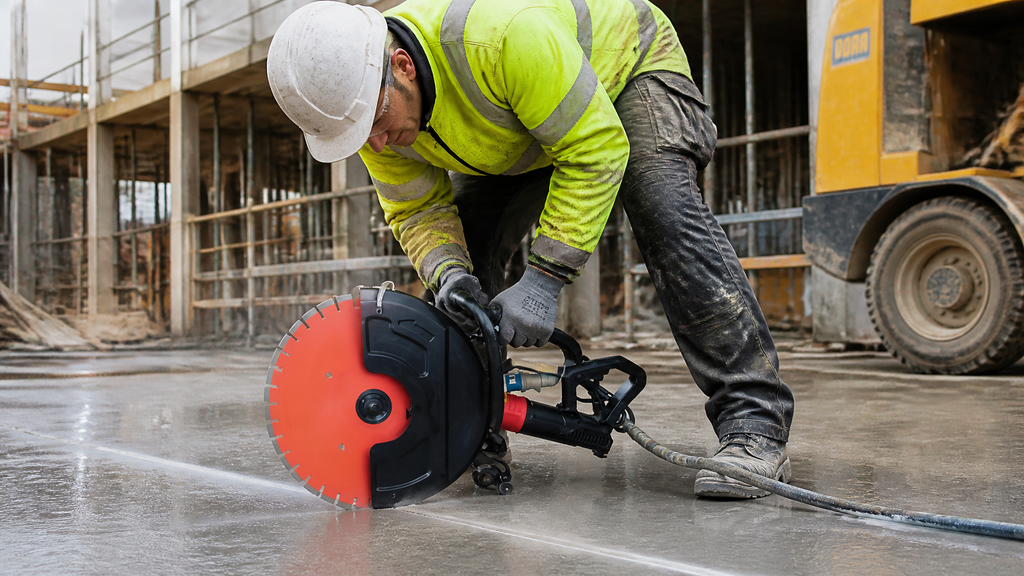
What Is a Concrete Cutter for Concrete Slab?
A concrete cutter for concrete slab is a professional cutting machine used to make precise cuts in hardened concrete or other construction materials.
The machine generally consists of a power unit, cutting blade, blade guard, depth adjustment system, frame, and operating handle. Depending on the machine design, it may be powered by gasoline, diesel, or electricity.
The cutting blade rotates at high speed and gradually penetrates the concrete surface. Diamond blades are commonly used because they provide excellent cutting performance and durability when working with reinforced or non-reinforced concrete.
Main Components of a Concrete Cutter
Understanding the main components helps operators choose suitable equipment and maintain consistent cutting performance.
| Компонент | Основная функция |
|---|---|
| Engine or Motor | Provides power for blade rotation |
| Алмазный диск | Cuts through concrete surfaces |
| Защита лезвия | Protects the operator from debris |
| Depth Adjustment System | Controls cutting depth |
| Water Supply System | Reduces dust and blade temperature |
| Machine Frame | Supports the machine structure |
| Operating Handle | Allows operators to control movement |
| Колеса | Support machine movement and positioning |
A professional concrete cutter for concrete slab should have a stable frame, reliable power transmission, and an effective depth adjustment system.
These features help reduce vibration, maintain cutting accuracy, and improve productivity during continuous construction operations.
Different Types of Concrete Cutter for Concrete Slab
Different construction projects require different concrete cutting machines. Selecting the right concrete cutter for concrete slab depends on the working environment, concrete thickness, cutting depth, and project requirements.
The following are the most common types of concrete cutters.
Ручной резак для бетона
A walk-behind concrete cutter is one of the most widely used machines for concrete slab cutting.
It is designed with wheels and an operating handle, allowing workers to guide the machine along a straight cutting line. The operator controls the cutting direction and adjusts the blade depth according to project requirements.
Main advantages include:
- Suitable for large concrete floors and slabs.
- Provides stable and straight cutting performance.
- Supports different diamond blade diameters.
- Suitable for construction joints and expansion joints.
- Available in gasoline and electric configurations.
A walk-behind concrete cutter for concrete slab is particularly suitable for construction contractors working on warehouses, industrial floors, parking areas, and road surfaces.
Gasoline Concrete Cutter
A gasoline concrete cutter uses an internal combustion engine to drive the cutting blade.
Because it does not require a direct electrical connection, it is suitable for outdoor construction sites and road maintenance projects where electrical power may not be available.
Key features:
- Independent power supply.
- Suitable for outdoor applications.
- Convenient for mobile construction projects.
- Available in different engine power configurations.
- Suitable for cutting thick concrete slabs when properly configured.
When purchasing a gasoline concrete cutter for concrete slab, contractors should consider engine displacement, rated power, blade diameter, fuel consumption, and cutting depth.
Электрический резак для бетона
An electric concrete cutter uses an electric motor to drive the cutting blade.
It is commonly used in indoor construction, factories, warehouses, and renovation projects where electricity is available.
К преимуществам относятся:
- Lower exhaust emissions during operation.
- Suitable for indoor environments with proper dust and water management.
- Relatively straightforward maintenance.
- Consistent power delivery when correctly sized.
- Available in different voltage configurations.
Before purchasing an electric concrete cutter for concrete slab, check the local voltage, frequency, motor power, and electrical connection requirements.
Ручной резак для бетона
A handheld concrete cutter is designed for smaller cutting operations and areas where large machines cannot easily access.
Обычно его используют для:
- Small concrete openings.
- Edge cutting.
- Repair work.
- Localized concrete removal.
- Cutting around pipes and structural obstacles.
Handheld machines offer flexibility and portability, but their cutting depth and continuous working capacity are generally more limited than those of walk-behind machines.
Heavy-Duty Concrete Cutter
Heavy-duty concrete cutters are designed for demanding construction applications involving thick concrete slabs and extended operating hours.
They typically feature:
- Higher engine or motor power.
- Stronger machine frames.
- Larger blade capacities.
- More stable cutting systems.
- Improved cooling and dust-control configurations.
For large infrastructure projects, a heavy-duty concrete cutter for concrete slab can help improve operational efficiency and maintain consistent cutting performance.
Common Applications of Concrete Cutter for Concrete Slab
A professional concrete cutter for concrete slab can be used in many construction and infrastructure projects.
Its versatility makes it an important machine for contractors, road construction companies, and concrete flooring specialists.
Concrete Floor Cutting
Concrete floor cutting is one of the most common applications.
Construction workers use concrete cutters to create control joints in newly placed concrete floors. These joints help control where shrinkage cracks develop as the concrete hardens.
К типичным областям применения относятся:
- Industrial workshops.
- Commercial buildings.
- Warehouses.
- Shopping centers.
- Factory floors.
- Residential concrete floors.
Using the correct concrete cutter for concrete slab helps contractors achieve consistent joint widths and cutting depths.
Road Construction and Maintenance
Concrete cutting is essential in road construction and pavement maintenance.
Road contractors use concrete cutters to remove damaged pavement sections, create expansion joints, and prepare surfaces for repairs.
К типичным областям применения относятся:
- Concrete highway maintenance.
- Road expansion joints.
- Airport pavement repairs.
- Bridge deck maintenance.
- Parking lot renovation.
- Concrete pavement replacement.
For these applications, a gasoline-powered concrete cutter for concrete slab is often preferred because of its mobility and independence from external electrical power.
Concrete Slab Renovation
During renovation projects, existing concrete slabs may need to be partially removed or modified.
A concrete cutter can create controlled cutting lines before demolition work begins.
This helps workers remove specific sections without unnecessarily damaging surrounding concrete.
Pipeline and Cable Installation
Construction projects frequently require openings in existing concrete surfaces for underground utilities.
A concrete cutter for concrete slab can help create cutting lines for installing:
- Water supply pipelines.
- Drainage systems.
- Electrical conduits.
- Communication cables.
- Heating and ventilation systems.
The operator should confirm the location of embedded pipes, cables, and reinforcement before cutting.
Industrial Floor Construction
Industrial floors often require precise joint layouts to accommodate shrinkage, temperature changes, and operational loading conditions.
A professional concrete cutter for concrete slab is commonly used to create these joints in warehouses, manufacturing facilities, and logistics centers.
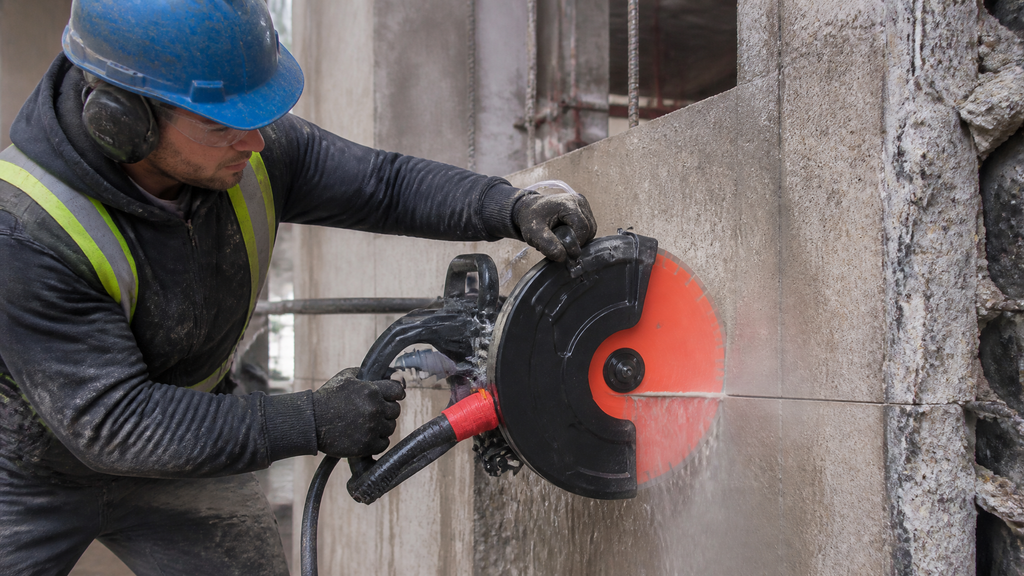
How to Choose the Right Concrete Cutter for Concrete Slab
Choosing the right concrete cutter is one of the most important purchasing decisions for contractors.
The machine should match the actual working conditions rather than simply having the highest power or largest blade.
Here are six important factors to consider.
Глубина реза
Cutting depth determines how deeply the blade can penetrate the concrete slab.
Different projects require different cutting depths.
Например:
- Thin concrete floors may require relatively shallow cuts.
- Industrial floors may require deeper joint cutting.
- Road construction projects may require larger cutting capacities.
- Thick reinforced concrete may require specialized heavy-duty equipment.
The maximum cutting depth depends on blade diameter, machine design, and blade mounting configuration.
Important: A machine’s maximum cutting depth is not necessarily equal to the blade diameter. The actual depth also depends on the blade radius, mounting position, and machine structure.
Диаметр лезвия
Blade diameter is another critical specification.
A larger blade generally provides greater potential cutting depth, but it also requires a compatible machine and sufficient driving power.
The following table shows common blade diameter categories and their typical applications.
| Диаметр лезвия | Типичные области применения |
|---|---|
| 300 mm | Small concrete cutting jobs |
| 350 mm | General concrete floor cutting |
| 400 mm | Medium-depth concrete cutting |
| 450 mm | Road and industrial floor applications |
| 500 mm | Deeper concrete slab cutting |
| 600 mm | Heavy-duty concrete cutting |
| 800 mm | Specialized deep-cutting applications |
These are general application references rather than guaranteed cutting-depth specifications. Always check the machine manufacturer’s maximum blade capacity.
Мощность двигателя
Power determines the machine’s ability to maintain blade rotation under cutting loads.
A concrete cutter for concrete slab with insufficient power may experience reduced cutting speed, unstable operation, or excessive load on the drive system.
When comparing machines, consider:
- Rated engine or motor power.
- Continuous operating capacity.
- Blade speed.
- Transmission efficiency.
- Cooling performance.
- Compatibility with the selected blade.
For heavy-duty applications, selecting a machine with an appropriate power reserve can help maintain stable performance.
Источник питания
The choice between gasoline and electric models depends on the construction environment.
| Сравнение | Gasoline Concrete Cutter | Электрический резак для бетона |
|---|---|---|
| Источник питания | Бензиновый двигатель | Электродвигатель |
| Мобильность | Высокий | Depends on power supply |
| Indoor Use | Requires exhaust ventilation | Suitable with appropriate controls |
| Outdoor Use | Very suitable | Suitable where electricity is available |
| Техническое обслуживание | Engine maintenance required | Motor and electrical maintenance |
| Noise | Generally higher | Generally lower |
| Typical Application | Road construction | Indoor and outdoor floor cutting |
A gasoline concrete cutter for concrete slab is often a practical choice for road contractors, while electric models are commonly selected for indoor and factory applications.
Система водяного охлаждения
Concrete cutting produces heat and dust.
Many professional concrete cutters are equipped with water supply systems that deliver water to the blade during operation.
Water cooling can:
- Reduce blade temperature.
- Help control airborne dust.
- Improve cutting conditions.
- Reduce the risk of overheating.
- Support longer cutting operations.
However, water requirements depend on the blade manufacturer’s recommendations and the cutting conditions.
Machine Stability and Operating Convenience
Machine stability directly affects cutting accuracy.
A suitable concrete cutter for concrete slab should have:
- A strong steel frame.
- Stable wheels.
- An adjustable cutting-depth system.
- An ergonomic handle.
- Reliable blade protection.
- Convenient water connections.
- Accessible maintenance components.
These features are especially important for contractors who operate cutting machines for extended periods.
Important Technical Specifications to Compare
Before purchasing a concrete cutter for concrete slab, buyers should compare the machine’s technical specifications.
The following table provides a practical purchasing checklist.
| Технические характеристики | What Buyers Should Check |
|---|---|
| Тип двигателя | Gasoline, diesel, or electric |
| Номинальная мощность | Whether it matches the cutting application |
| Диаметр лезвия | Maximum supported blade size |
| Maximum Cutting Depth | Actual machine cutting capacity |
| Blade Speed | Compatibility with the blade |
| Водяной бак | Capacity and water supply method |
| Cutting Adjustment | Manual or hydraulic adjustment |
| Вес машины | Stability and transportation requirements |
| Machine Dimensions | Suitability for the working site |
| Способ эксплуатации | Walk-behind or handheld |
Different manufacturers may use different configurations. Buyers should request a complete specification sheet before placing an order.
Diamond Blades for Concrete Cutter for Concrete Slab
The diamond blade is one of the most important components of a concrete cutter.
Even when a machine has sufficient power, an unsuitable blade can reduce cutting efficiency and increase operating costs.
Types of Diamond Blades
Different blade designs are suitable for different cutting requirements.
| Тип лезвия | Основные особенности | Typical Application |
|---|---|---|
| Segmented Diamond Blade | Segmented cutting edge | General concrete cutting |
| Laser-Welded Blade | Strong segment attachment | Demanding cutting applications |
| Turbo Diamond Blade | Designed for efficient cutting and debris removal | Selected concrete cutting jobs |
| Continuous Rim Blade | Continuous cutting edge | Fine cutting of suitable materials |
The correct blade depends on the concrete material, machine power, required cutting speed, and operating conditions.
Cutting Reinforced Concrete
Reinforced concrete contains steel bars embedded inside the concrete structure.
Cutting reinforced concrete places additional demands on the blade.
Before selecting a diamond blade, consider:
- Concrete hardness.
- Reinforcement density.
- Aggregate type.
- Blade bond hardness.
- Machine power.
- Wet or dry cutting requirements.
A blade designed for ordinary concrete may not provide optimal performance when cutting heavily reinforced concrete.
How to Extend Diamond Blade Life
Proper blade selection and operation can help reduce unnecessary wear.
Recommended practices include:
Select a blade suitable for the concrete material.
Use the correct blade speed.
Avoid excessive downward pressure.
Maintain an appropriate water supply when wet cutting.
Check the blade for cracks and damaged segments.
Stop operating if unusual vibration occurs.
Replace worn blades according to the manufacturer’s recommendations.
How to Operate a Concrete Cutter for Concrete Slab
Correct operating procedures help improve cutting quality and reduce workplace risks.
The following steps provide a general operating reference for walk-behind concrete cutting machines.
Проверить машину
Before starting the machine, check:
- Engine or motor condition.
- Установка лезвия.
- Blade guard.
- Water supply system.
- Wheels and handles.
- Fuel or electrical connections.
- Emergency stopping arrangements.
Never operate a concrete cutter with a damaged blade or missing safety guard.
Mark the Cutting Line
Use a chalk line or another suitable marking tool to identify the cutting position.
Accurate marking helps the operator maintain straight cutting lines and reduces unnecessary material removal.
Install the Correct Blade
Select a blade that matches the machine’s specifications and the concrete material.
Check the blade’s maximum permitted operating speed and ensure that it is compatible with the machine’s spindle speed.
Adjust the Cutting Depth
Set the required cutting depth according to the project drawings and concrete slab requirements.
Avoid forcing the blade to reach maximum depth in one pass if the machine or blade is not designed for that operation.
Start the Machine
Start the machine according to the manufacturer’s operating instructions.
Allow the blade to reach the required operating speed before beginning the cut.
Begin Cutting
Guide the concrete cutter along the marked line at a controlled speed.
Avoid pushing the machine too quickly. Excessive feed pressure can cause blade overheating, reduced cutting performance, and unnecessary mechanical stress.
Complete the Cutting Operation
After reaching the required cutting depth, stop the machine according to the manufacturer’s procedure.
Inspect the finished cutting line and clean the working area using appropriate dust-control methods.
Safety reminder: Operators should wear suitable eye protection, hearing protection, respiratory protection, gloves, and protective footwear. Before cutting existing slabs, check for embedded utilities and structural reinforcement. Follow applicable silica-dust control regulations and the machine manufacturer’s safety instructions.
Common Problems When Using a Concrete Cutter for Concrete Slab
Even professional equipment may experience operating problems if the machine is improperly configured or maintained.
Understanding common issues can help operators identify problems quickly.
| Common Problem | Возможная причина | Рекомендуемое решение |
|---|---|---|
| Slow Cutting Speed | Unsuitable blade or insufficient power | Check blade selection and machine capacity |
| Excessive Blade Wear | Incorrect blade bond or operating conditions | Use a suitable blade |
| Blade Overheating | Insufficient cooling or excessive pressure | Check water supply and cutting technique |
| Uneven Cutting Line | Machine instability or incorrect guidance | Check wheels and operating alignment |
| Чрезмерная вибрация | Damaged blade or incorrect installation | Stop and inspect the blade |
| Engine Overheating | Poor ventilation or maintenance issues | Inspect the engine cooling system |
| Difficult Cutting | Excessive reinforcement or unsuitable blade | Select equipment for the actual material |
Operators should never continue using a machine when unusual vibration, blade damage, or abnormal mechanical noise occurs.
Concrete Cutter for Concrete Slab vs. Other Cutting Methods
Contractors sometimes compare concrete cutters with angle grinders, handheld saws, and demolition equipment.
Each tool has a different purpose.
| Equipment | Основная функция | Подходящие области применения |
|---|---|---|
| Бетонорез | Straight concrete cutting | Slabs, roads, expansion joints |
| Angle Grinder | Small-scale surface cutting | Edges and localized cutting |
| Handheld Cut-Off Saw | Portable cutting | Small openings and repairs |
| Demolition Hammer | Breaking concrete | Concrete removal |
| Wall Saw | Controlled structural cutting | Walls and vertical concrete |
| Wire Saw | Specialized deep or complex cutting | Large structural sections |
A dedicated concrete cutter for concrete slab is generally more suitable for long, straight floor cuts than handheld equipment.
It provides a stable cutting platform and supports larger blades for appropriate applications.
However, complex structural cutting may require specialized wall saws or wire saw systems.
How to Maintain a Concrete Cutter for Concrete Slab
Regular maintenance helps extend machine service life and reduce unexpected downtime.
A professional concrete cutter for concrete slab should be inspected before and after operation.
Ежедневное техническое обслуживание
- Clean concrete dust and slurry from the machine.
- Inspect the diamond blade.
- Check the blade guard.
- Confirm that the water supply system works properly.
- Проверьте болты и крепежные элементы.
- Inspect wheels and operating handles.
- Check the engine oil and fuel system where applicable.
Еженедельное техническое обслуживание
- Inspect the drive belt.
- Check blade shaft and bearing condition.
- Inspect the water pipes and connections.
- Check the depth adjustment mechanism.
- Examine electrical cables and connectors on electric models.
- Lubricate components according to the manufacturer’s instructions.
Long-Term Maintenance
- Replace worn components when necessary.
- Inspect the transmission system.
- Maintain the engine according to its service schedule.
- Store the machine in a dry environment.
- Remove accumulated concrete slurry.
- Keep spare blades and essential replacement parts available.
Maintenance Schedule
| Пункт технического обслуживания | Рекомендуемая частота |
|---|---|
| General Machine Inspection | Before Every Operation |
| Проверка лопастей | Before and After Every Operation |
| Cleaning | After Every Operation |
| Проверка уровня моторного масла | According to Engine Manual |
| Drive Belt Inspection | Weekly or as Required |
| Bearing Inspection | Periodically |
| Electrical System Inspection | Periodically |
| Complete Machine Inspection | According to Manufacturer Schedule |
Maintenance intervals should be adjusted according to operating intensity and environmental conditions.
Почему стоит выбрать профессионального производителя бетонорезов?
For international buyers, selecting a reliable manufacturer is just as important as selecting the correct machine.
A professional concrete cutter manufacturer should provide more than just equipment. Product consistency, technical support, spare parts availability, and export experience are also important.
When evaluating a concrete cutter for concrete slab supplier, consider the following factors.
Опыт работы в производственной сфере
An experienced manufacturer understands different construction environments and can recommend suitable machine configurations.
Manufacturing experience is particularly important for buyers who need customized voltage, blade diameter, engine configuration, or other specifications.
Product Quality Control
Reliable manufacturers should conduct quality inspections before shipment.
Important inspection items include:
- Engine or motor performance.
- Blade rotation stability.
- Machine frame strength.
- Cutting-depth adjustment.
- Water supply performance.
- Electrical safety where applicable.
Наличие запасных частей
A stable spare parts supply is essential for international distributors and construction equipment rental companies.
Common spare parts include:
- Diamond blades.
- Drive belts.
- Bearings.
- Engine components.
- Water pipes.
- Switches and electrical components.
- Fasteners and adjustment components.
OEM and Customization Services
Different markets may require different machine configurations.
A professional supplier should be able to discuss:
- Local voltage and frequency.
- Gasoline engine requirements.
- Диаметр лезвия.
- Cutting depth.
- Machine color and logo.
- Packaging requirements.
- Spare parts combinations.
These services help importers and distributors develop products suitable for their local markets.
Why Choose Shandong Huashuo Machinery?
Компания «Shandong Huashuo Machinery Manufacturing Co., Ltd.» специализируется на производстве оборудования для дорожного строительства и бетонирования и имеет более чем 10-летний опыт в этой области.
Our product range includes concrete cutters, concrete floor grinders, power trowels, and other construction machinery.
We understand that different customers have different requirements depending on their construction projects, local working environments, and equipment standards.
When choosing a concrete cutter for concrete slab, buyers need reliable equipment that combines practical performance, convenient operation, and long-term serviceability.
Our company focuses on providing:
- Factory-direct manufacturing and supply.
- Different machine configurations for various applications.
- Product customization according to customer requirements.
- Spare parts support.
- International export experience.
- Professional communication and technical assistance.
Whether you are a construction contractor, machinery distributor, equipment importer, or rental company, selecting the right concrete cutter is essential for your business.
Contact Shandong Huashuo Machinery to discuss your concrete cutting requirements and find a suitable machine for your market.
Заключение
Choosing the right concrete cutter for concrete slab is essential for achieving accurate cutting results, improving construction efficiency, and reducing unnecessary equipment downtime.
Before purchasing a machine, contractors should carefully evaluate the concrete thickness, required cutting depth, blade diameter, engine or motor power, power source, and operating environment.
Walk-behind concrete cutters are suitable for large floor and pavement projects, while gasoline models offer excellent mobility for outdoor construction. Electric models are practical for many indoor applications, and handheld cutters provide flexibility for smaller cutting jobs.
In addition to machine specifications, diamond blade selection, correct operating procedures, and regular maintenance all influence cutting performance.
For international buyers, working with an experienced manufacturer also provides advantages in product customization, technical support, and spare parts supply.
If you are looking for a reliable concrete cutter for concrete slab, Shandong Huashuo Machinery can help you evaluate different machine configurations and select suitable equipment for your construction applications.
Contact us today to learn more about our concrete cutting machines and manufacturing capabilities.
Если вам нужно бетонорезы,cбетон gкрупный рогатый скотs,cбетон pовер tшпорилкаs или по любым другим вопросам — обращайтесь к нам!
Электронная почта: teresa@huashuo-machine.com
WhatsApp: +86 15554448948
Facebook: https://www.facebook.com/profile.php?id=61560318418325
Tik Tok: https://www.tiktok.com/@huateresa
Часто задаваемые вопросы
What is the best concrete cutter for concrete slab?
The best concrete cutter depends on the slab thickness, cutting depth, working environment, and project size.
Walk-behind concrete cutters are commonly used for large concrete floors and road construction. Gasoline models are suitable for outdoor applications, while electric models are practical for indoor projects where an appropriate power supply is available.
What size concrete cutter do I need for a concrete slab?
The required machine size depends mainly on the concrete thickness and desired cutting depth.
For smaller projects, a machine supporting 300–350 mm blades may be sufficient. For deeper cuts, contractors may need machines supporting 400–600 mm or larger blades.
Always check the manufacturer’s specified maximum cutting depth rather than selecting a machine based only on blade diameter.
Can a concrete cutter cut reinforced concrete slabs?
Yes. A suitable concrete cutter for concrete slab can cut reinforced concrete when equipped with an appropriate diamond blade and sufficient power.
However, cutting performance depends on reinforcement density, steel bar diameter, concrete hardness, and blade specifications.
For heavily reinforced structures, specialized equipment and professional cutting procedures may be necessary.
How deep can a concrete cutter cut?
Cutting depth depends on blade diameter, machine design, and blade mounting position.
Different machines offer different maximum cutting capacities. Buyers should confirm the actual cutting depth with the manufacturer before purchasing.
Что лучше выбрать: бензиновый или электрический бетонорез?
Choose a gasoline concrete cutter if you mainly work outdoors and require independent power.
Choose an electric concrete cutter if you work in factories, warehouses, or indoor construction environments where electricity is available.
The final decision should consider power requirements, local regulations, operating conditions, and maintenance preferences.
What blade is best for cutting concrete slabs?
Diamond blades are widely used for concrete slab cutting.
Segmented diamond blades are common for general concrete cutting, while specialized blades may be required for reinforced concrete or specific aggregate conditions.
The blade must match the machine’s specifications and recommended operating speed.
Can a concrete cutter be used for road construction?
Yes. A professional concrete cutter for concrete slab is widely used in road construction and maintenance.
Typical applications include cutting expansion joints, removing damaged pavement sections, repairing concrete roads, and preparing surfaces for reconstruction.
How do I reduce dust when cutting concrete slabs?
Using a compatible wet-cutting system can help reduce airborne dust during concrete cutting.
For dry cutting, use suitable dust extraction equipment and follow applicable silica-dust control requirements.
Operators should always wear appropriate respiratory protection.
How often should I replace the diamond blade?
There is no fixed replacement interval because blade life depends on concrete hardness, aggregate type, reinforcement, cutting depth, operating speed, and maintenance.
Replace the blade when it becomes excessively worn, damaged, or unable to deliver safe and effective cutting performance.
What should I check before buying a concrete cutter for concrete slab?
Перед покупкой проверьте:
- Maximum blade diameter.
- Maximum cutting depth.
- Engine or motor power.
- Blade speed.
- Water supply system.
- Machine weight and dimensions.
- Local voltage and frequency.
- Наличие запасных частей.
- Manufacturer warranty and technical support.
Comparing these specifications helps ensure that the selected concrete cutter for concrete slab meets your actual project requirements.